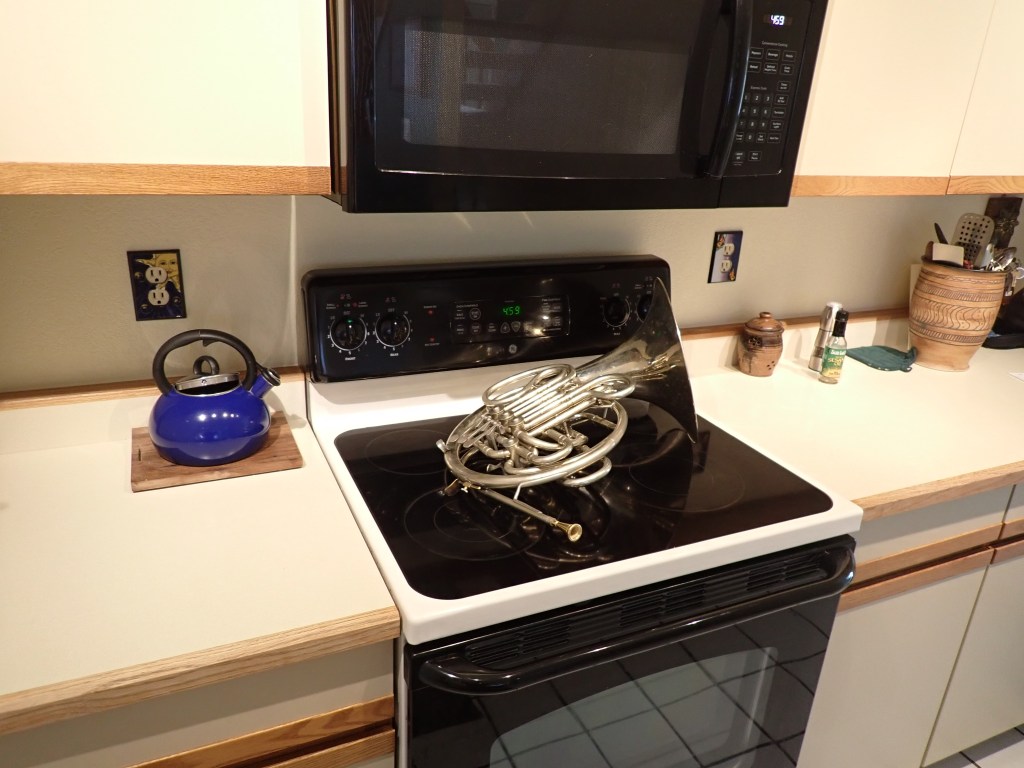
The French horn has been the focus of my life and I am so lucky to have made it my profession; lucky too, to have been able to practice and play the horn in beautiful Colorado and Wyoming.
This page, however, is to share the most difficult part of that journey, a diagnosis of focal dystonia, which lead to the end of my career with the Colorado Symphony, but opened up so many other joys and challenges.
Now, for the first time in my life since I was thirteen years old, I am not practicing, performing or teaching. Instead, I wish to share with you the discoveries which helped me to play again. I may not have the answers to solve your embouchure problems, but these things may be worth a try.
Feel relaxed and joyful! Very hard to do when what you love so much is on the brink. That goes especially for your practice time. Sit down and put the horn back down on your leg. Practicing standing and with the horn off the leg will not help you relax. I did not feel I could get the sound I wanted in Boettcher Concert Hall with the horn on my leg. The sound seemed to go nowhere. I also thought I could take in more air if the horn was up. So I played all the time with the horn off my leg. If you are feeling great, playing standing or with the horn free is great. If you are trying to fix things, put it back down!
Set aside a minimum of an hour for exercise every day…and horn practice does not count. For me, swimming was the best, although I enjoy hiking and biking too. Swimming is low impact, and the breathing can be made very similar to what you need to do to play well.
Build a routine that starts with attacks in your easiest register and volume, and spread out. Want specifics? I’m here to help, and I do not charge anything. I can show you the exercise I use and how to gradually increase in several ways. I use a well rounded routine, but the attacks do the most good.
Pay attention to your embouchure set-up, with as much focus as you do to the quality of your breathing, tone and clarity of tonguing. What I mean by this is to create a thick shape, somewhere between relaxed and whistling, but closer to whistling. Do this before you put the mouthpiece on your lips. Great players are always talking breathing, tonguing, embouchure placement, etc. These are absolutely of fundamental importance, but if the set-up is wrong, all your great training will be impaired. Forrest Standley taught me the correct set, but as my career progressed, I gradually changed to a thinner set, probably as a result of too much playing. This thinner set felt more natural and reliable too, so I accepted it as correct. As this thinning occurred, the mouthpiece moved a little higher as well, tension increased, and worst of all, I developed a huge break in the middle register. (I was able to fix this, and you can too!)
Don’t use a mirror! I thought I could fix problems if I could see them. The fact is that you can look relaxed and still be tense. Perhaps you have a preconceived idea of what a correct embouchure should look like. By using a mirror, you are heading toward that idea instead of evolving again to what will work for you! Think of this: a great singer will never see his / her instrument!
Make some music! I’m a believer in drills and exercises, but if you are not singing on the horn, forget it. Play one beautiful phrase, then some excerpts, then a favorite movement from a solo. Enjoy!!!
I have pages of practicing notes, but if you have read this far, you will have read the most helpful ideas. I can tell you a lot about focal dystonia and other embouchure problems. I’m happy to share my experience with you with a Zoom meeting or Face Time chat. You will have to solve your own problems, but perhaps I can save you time. Get in touch.
 Seven Rivers Railroad